Read more at:
You probably heard the news that PlayStation is ditching physical games for an all-digital future. Starting in 2028, the company will no longer produce discs for PlayStation games. Basically nobody on the internet liked this idea, but it got us thinking: Does Sony have a point? Doesn’t game data last longer on hard drives than it does on discs? Not by a long shot.
To paraphrase Benjamin Franklin, “In this world, nothing is certain except death and taxes,” and that applies to physical game discs. Even though they’re made out of artificial materials, all CDs, DVDs, and Blu-rays have a set life expectancy; eventually all your discs will become unreadable via a process known as “disc rot.” While we’re used to many modern devices falling apart by design (this planned obsolescence is why tech from the ’60s feels more futuristic than what we have), disc rot is just the natural degradation of chemicals that are found within all physical discs. However, the exact time it takes for disc rot to set in depends on a variety of factors.
As a general rule of thumb, different disc types have different life expectancies, and game manufacturers swapped formats between generations. The original PlayStation console used standard CDs, whereas the Xbox relied on DVDs, both of which last at least 25 years but can hypothetically survive over 100. Nowadays, game discs utilize Blu-ray technology, which have an average lifespan of 10 to 20 years — more if stored properly. Of course, since all game discs are mass produced, quality is never guaranteed. If the disc printing plant isn’t quite up to standard, or some contaminant gets in the disc before the data is written, it’ll rot faster than normal.
Which lasts longer: The game console or the game disc?

While disc rot is inevitable, you can stave it off by storing your game discs in cool, dry locations. If you see a disc with strange discolorations, then the process has already begun. But depending on how far along the rot is, your console should still be able to read the disc. Depending on the disc reader, you might even be able to digitize your physical game collection. But do you really want to?
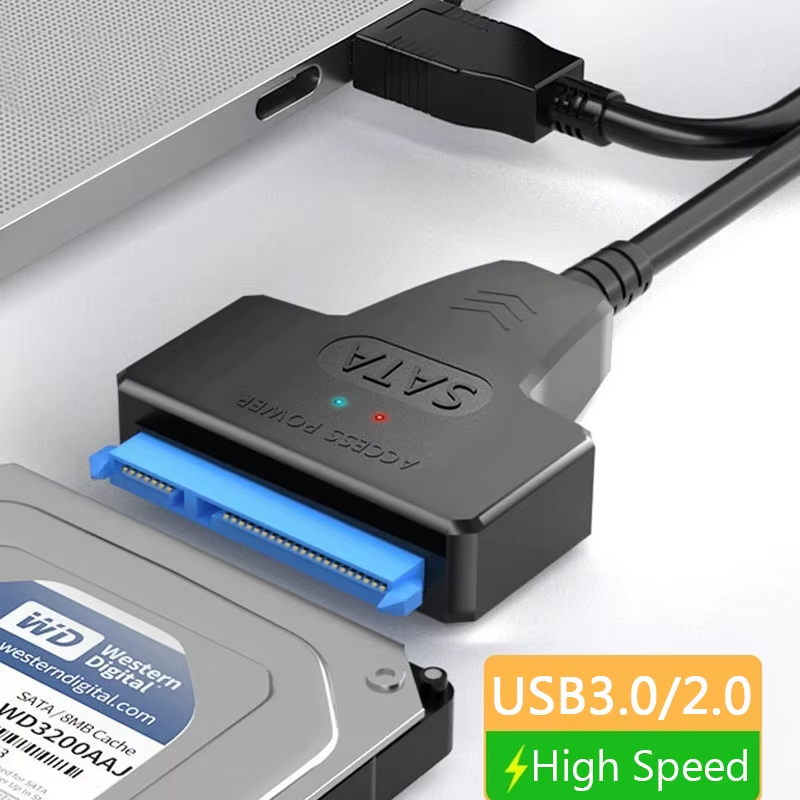
As we previously established, game discs can last upwards of 25 years. To put that into perspective, the original Xbox and Nintendo GameCube released just over 25 years ago. Back then, games were stored on discs; you didn’t need to (and couldn’t) install them on your consoles. If you install game data on modern hard drives, you don’t have to worry about losing your library to disc rot. Instead, you have to worry about losing them to the standard wear and tear that hard drives deal with every single day, which works considerably faster than disc rot. On average, hard drives have a lifespan of three or five years. Comparatively, SSDs don’t have any moving parts, so last twice as long.
Ultimately, the tradeoff of storing games on drives isn’t worth it. At best, you’re getting around 10 years of storage, which is less than half of a PlayStation 1 or Xbox disc’s projected lifespan at the low end. While SSDs are generally reliable for long-term storage (and speedy to boot), they pale in comparison to the game discs of yesteryear. Modern physical games do have the potential to become essentially useless if the servers for a game that requires an internet connection are shutdown, or the disc merely serves as a license key and the actual game download is taken offline, but digital copies could theoretically also be negatively effected by either of those factors.