Read more at:
Modern smartphones are more powerful than older desktops, to the point that you can open lots of apps and play AAA games. You can even use them as a desktop PC in the office with features like Samsung DeX. While playing a game on your phone can make it hotter than usual, it still dissipates heat efficiently without the need for a fan. So how can that be, considering that they have only gotten more powerful and smaller over the years?
Smartphones have a passive cooling system that moves heat away from the phone’s internal components and onto its surface, where it is expelled. It’s not perfect, but it works when the phone is used normally. Also, their components don’t consume a lot of power, which keeps heat generation to a minimum. When they get too hot, smartphones switch to secondary control measures that stop additional heat generation until everything cools down.
These are some of the biggest reasons why smartphones don’t need fans on the same level that computers do. Besides that, fans are bulky and consume a lot of power, which is not a practical or efficient design for a gadget that’s meant to fit in your hand and be used throughout the day. Furthermore, fans are mechanical liabilities that can’t take the level of abuse that we put our phones through (all that dropping, banging, and bumping) without eventually breaking.
Low power consumption and passive cooling
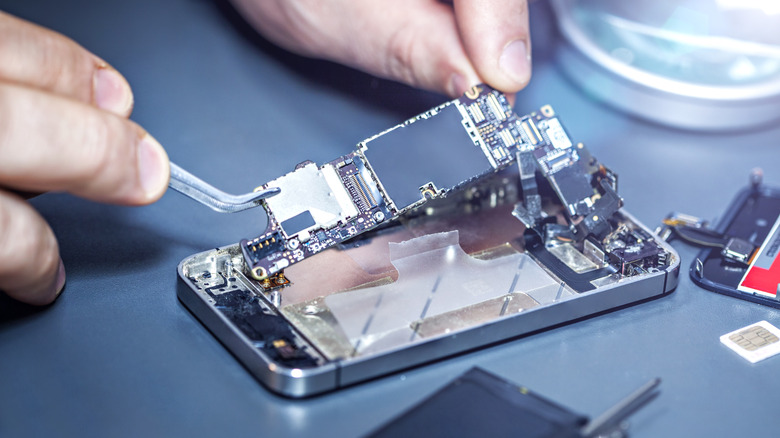
A major reason phones don’t need a fan is that they use passive cooling systems that turn their surface into a big heat sink (an object that dissipates heat). Some phones, especially flagship and gaming phones, use liquid cooling. An example is vapor chambers, which are tightly sealed containers with a special coolant inside. When near the System-on-Chip (SoC), which includes the GPU, CPU, and memory (RAM), the liquid boils due to the heat from these components, evaporating into a vapor that transfers heat to the phone’s surface. It then condenses back into liquid, moving back to the SoC to repeat the process over and over.
Some phones dissipate heat using cooling materials like graphite sheets and thermal paste that spread heat across the phone’s surface. Phones with bigger cooling needs, like the Asus ROG Phone 9 and ROG Phone 9 Pro, use both vapor chambers and passive materials.
Another reason phones are better at cooling themselves is that the SoC doesn’t consume a lot of power, which makes sense because phones run on batteries. Essentially, the more voltage or current a component draws, the hotter it gets. For instance, streaming a 4K video on YouTube or Netflix will put a higher load on these components, forcing them to draw more power from the battery to sustain performance. As a result, the phone gets hotter, and the battery drains more quickly.
Smartphones can protect themselves from excessive heat

If the primary cooling systems aren’t enough, the phone will switch to secondary safety mechanisms. A common one is throttling, which reduces the CPU clock speed (how fast it executes instructions). Throttling forces the CPU to slow down, reducing the amount of voltage it draws to minimize heat generation. That’s why your phone becomes sluggish when it gets hot — the CPU is throttling itself so it can cool down.
One scenario that can force a phone to do this is when you’re playing a game like “Call of Duty: Mobile” at maximum settings. Doing so while the phone is charging compounds the problem. As already mentioned, the power needed for the high-load tasks already generates a lot of heat. When you couple that with the heat generated by the battery as it draws power from the outlet, this bad charging habit is a recipe for overheating.
If these measures aren’t enough, you may get a warning that your phone is overheating and needs to cool down. It can also shut down to protect its internal components from heat damage. Although, for a phone to reach that point, it must be exposed to extreme heat, such as leaving it in direct sunlight, in a hot car, or under a pillow while charging. These measures also protect the lithium-ion battery. It can undergo significant thermal degradation when subjected to temperatures outside its safe operating range. It also protects you, because an overheating phone can explode.