Read more at:
When it launched in 2022, the Steam Deck opened up handheld gaming to a new level that the Sony PS Vita and the Nintendo Switch couldn’t before, thanks in large part to the Steam Store’s Babylonian library of titles. It was a fair deal for its time, although Valve did roll out a massive Steam Deck price hike earlier this year following component price increases caused by AI permeating the tech industry and beyond. That said, whether you have a Steam Deck LCD or OLED, you’re getting performance that can keep up with a Switch 2 while retaining the all-around flexibility of a PC.
The Steam Deck runs on an AMD accelerated processor unit (APU) that was custom-designed for the machine, and its integrated GPU was built off the same RDNA architecture that the Radeon 660M and 680M were, both of which are also from 2022. You might be wondering how well the Steam Deck’s GPU stacks up against other AMD graphics cards: on paper, it is specced out right between the 660M and 680M and performs accordingly in benchmarks. But if you’re looking for closer equivalents, 3DMark’s benchmark results suggest you would find its rough AMD GPU equivalent in an entry-level Radeon RX 550 for desktops from 2017 or a laptop-grade Radeon RX 560X from 2018. That said, benchmark tests don’t tell the whole story here.
The Steam Deck GPU works well for its intended purpose
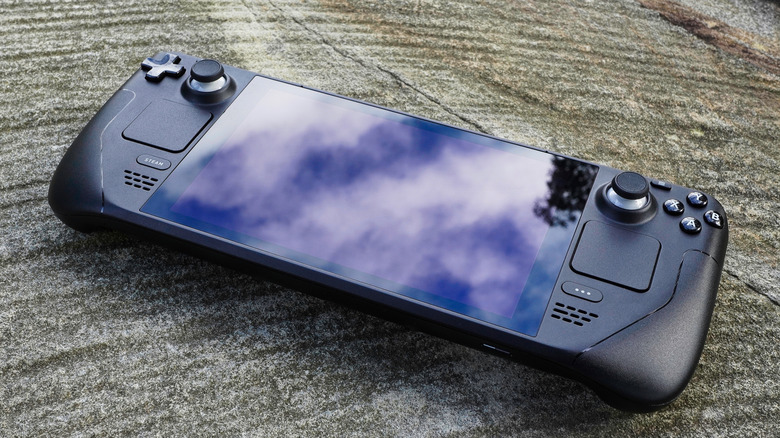
Before you start muttering about how your old gaming laptop is better than both the Steam Machine and the Steam Deck, there are a couple things to keep in mind. First is the nature of APUs. AMD pioneered their APU design as a way to boost output for a given wattage — crucial in mobile products where that efficiency on battery power is valuable. The Steam Deck’s GPU lives on the same die as the CPU and shares 16GB of LPDDR5 memory with it on a power budget between 4 and 15 watts. On laptops, discrete GPUs draw upwards of 30, 40, and even 50 watts and tap into a small pool of dedicated, super-fast GDDR memory.
It is naturally difficult to get one-for-one in-game comparisons with so many hardware and software contingencies in play. We reviewed Cyberpunk 2077 footage being played on the Steam Deck APU as well as a Radeon RX 550 tied to a Ryzen 5 5500 — at roughly the same settings, of course — and found that while the Steam Deck averaged 40 to 50 frames per second with Intel XeSS 2.0 upscaling on, the RX 550 starts in that range without upscaling, blasting through to the 60s with AMD’s FSR 3.0 tech. Don’t get us wrong: the Steam Deck provides a decently playable experience here, especially on its built-in 1280×800 screen, and you might be able to squeeze good 1080p output on certain lightweight titles when connected to an external display. But, as ever, your mileage may vary.
On pure silicon, the Steam Deck was outdone by Asus and Lenovo with their respective ROG Ally and Legion Go handhelds. These newer entries come with more powerful AMD Ryzen Z1 and Z1 Extreme chipsets, along with newer Radeon 780M integrated graphics and a thermal design power (TDP) range of 9 to 30 watts. That said, putting the raw specs gap aside, there’s still reasonable room for debate about which gaming handheld on the market you should really buy.