Read more at:
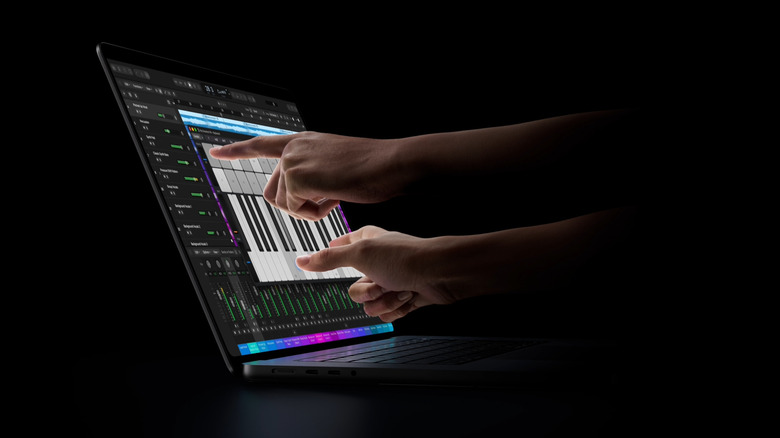
After years of rumors, Apple finally announced its first touchscreen MacBook Pro models on October 28. In addition to being a touchscreen, the new display also uses an OLED panel (dubbed PROLED XDR) for the first time in a MacBook, building on the iPad Pro‘s tandem OLED tech.
The new machine comes in two sizes — 14-inch and 16-inch — both of which are thinner and lighter than the previous generation. The new MacBook Pro also brings back the glowing Apple logo on the lid, ditches the notch in favor of a pill-shaped camera cutout with a Dynamic Island, and comes with the same M5 Pro and M5 Max chips.
The 14-inch model starts at $2,899 and the 16-inch at $3,399, which gives the 14-inch the highest starting price of any MacBook Pro Apple has launched. Both machines arrived at Apple’s “Pro and Tell” event in Los Angeles, a day after the company introduced a new 14-inch MacBook Pro and a new iMac, both with the M6 chip. The non-touch M5 Pro and M5 Max MacBook Pro models will remain on sale.
Apple’s first touchscreen MacBook

The new MacBook Pro uses an OLED panel, which will be a big upgrade for anyone currently using one of these machines, since Apple has used mini-LED panels since 2021. Switching to OLED means the machines can deliver the same per-pixel lighting that gives the iPhone and iPad Pro their deeper blacks and higher contrast. Apple quotes up to 2,000 nits of peak brightness for both HDR and SDR content, a 10,000,000:1 contrast ratio, and a refresh rate that varies from 10Hz to 120Hz. The panel covers P3 and Adobe RGB, and the nano-texture option is etched directly into the cover glass.
But the most eye-catching upgrade is that the new MacBook offers touch input across the whole display, on both the 14-inch and 16-inch models. To fully take advantage of the new display, macOS 27 has been revised for fingers rather than just a trackpad. Existing apps will work without any changes, since macOS simply translates a touch into a click. The Dynamic Island also becomes the home for Spotlight, Live Activities, and Siri AI, so searching your Mac or asking Siri a question happens at the top of the screen. The touch sensor sits inside the display panel rather than on top of it, which Apple says reduces latency.
Apple spent years telling people it had no interest in putting a touchscreen on a Mac — despite building working prototypes — so this inclusion is a major change for the tech company. Apple’s new CEO, John Ternus, reportedly spearheaded the development of the new machine. His position was that Apple had fallen behind on this, and that a touchscreen had become something buyers expect on a laptop rather than a differentiator. Touchscreen Windows laptops have been around for more than a decade, though touch barely registers in the laptop rankings Consumer Reports puts together.
A thinner body and a steadier hinge
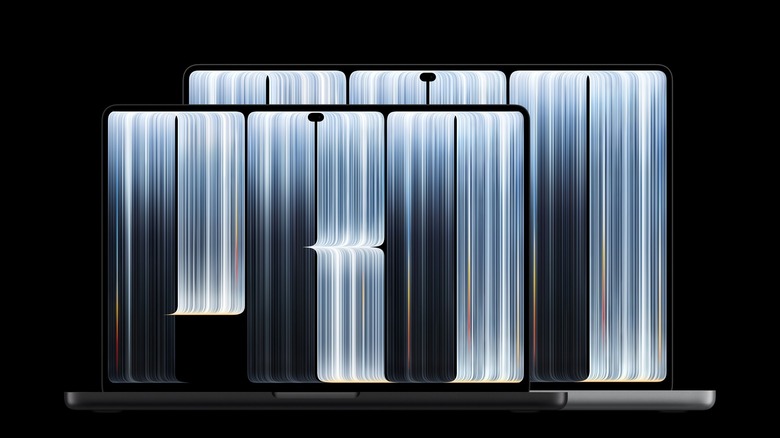
The rest of the MacBook Pro also gets somewhat of a redesign. By far the biggest update is the return of the glowing Apple logo on the lid — a fan-favorite feature that was axed back in 2015. Alongside it, the chassis is slightly thinner, the bezels around the display are thinner, and the new machines are noticeably lighter than the models they replace. The 14-inch model drops half a pound to land at 3 pounds, while the 16-inch is 4 pounds. The 16-inch is nearly a millimeter thinner and the 14-inch is half a millimeter thinner, and those slimmer borders grow the screens to 14.2 inches and 16.3 inches. That being said, the overall shape carries over — it still looks like a MacBook Pro.
 Apple
The hinge seems to have received most of Apple’s attention, for obvious reasons. Pressing and poking a laptop screen pushes it backward. On most touchscreen laptops, the display rocks every time you tap it. To avoid this, Apple designed its MacBook hinge to hold the display steady even when a finger is prodding at it. This difference will make the MacBook Pro’s touchscreen feel solid, which is what you’d expect from such a premium machine. Apple has also added video stabilization that smooths the camera feed if you touch the screen during video calls.
Apple reworked the thermal system as well to move air through the hinge, which should improve airflow and cut weight at the same time. Routing heat through the hinge assembly frees up space elsewhere in the chassis, which is part of how these machines got lighter while maintaining the same M5 Pro and M5 Max performance.
M5 Pro and M5 Max chips inside
The ports are the same, with three Thunderbolt 5 connections, HDMI, an SDXC card slot, MagSafe, and a headphone jack. It can support three external displays on M5 Pro and four on M5 Max. Battery life runs up to 24 hours, and the six-speaker system gets a new woofer design that Apple says delivers 50% deeper bass.
These machines come with the M5 Pro and M5 Max chips, which are the same options as the MacBook Pro models that Apple released in March. Apple announced a cheaper 14-inch MacBook Pro on October 27, which comes with the newer M6 chip that debuted in the Mac mini in August. The lineup is a little confusing, as Apple’s newest chip is in its least expensive MacBook Pro, but the more powerful ones are in the more expensive machines.
The M5 Pro and M5 Max processors carry considerably more CPU and GPU cores than the M6 chip and far higher memory bandwidth. That’s why the current M5 Max MacBook Pro is as quick as it is during video exports and 3D renders, particularly. If you already own a MacBook Pro with the M5 Pro or M5 Max, upgrading to the new model won’t get you any extra performance. The configurations do go further than before, with up to 128GB of unified memory and up to 16TB of storage available.
Instead, buyers can now pick between two designs. The M6 14-inch MacBook Pro offers the newest chip, the existing chassis, and a mini-LED display at $1,999. Apple is keeping the non-touch M5 Pro and M5 Max models on sale too, at $2,499 for the 14-inch and $2,999 for the 16-inch if you want the extra power in a familiar chassis. Then, these touchscreen models offer the OLED panel, the lighter body, and the Pro and Max chips at a considerable premium.
Price and availability
The 14-inch touchscreen MacBook Pro starts at $2,899 and the 16-inch at $3,399 with M5 Pro, which is $400 more than the non-touchscreen versions of each size. The M5 Max versions cost considerably more, starting at $4,499 for the 14-inch and $4,799 for the 16-inch. Pre-orders open on October 28, with both models arriving on November 6. That makes the 14-inch the most expensive MacBook Pro Apple has ever introduced at launch, surpassing the $2,799 the company charged for the 17-inch model in 2006.
Price hikes hit the Mac, iPad, and iPhone lines in June due to the increasing memory and storage costs. Before June, the 14-inch M5 Pro MacBook Pro started at $2,199 and the 16-inch at $2,699, so the touchscreen models represent a jump of at least $700 in four months.
For anyone that currently has an Intel MacBook Pro or an M1 model, the new MacBook Pro offers several years of improvements at once. Macs tend to stay useful long enough to make that cost pay off over years. Anyone that already owns an M5 Pro or M5 Max MacBook Pro will be paying $700 or more for a touchscreen, a lighter body, and a better panel, with the same chip inside.