Read more at:
Amazon, a heavy investor in AI, has pioneered a technology it says will make its data centers both more resilient and more power efficient. A 2026 report by Wired shared that Amazon claims the new architecture will allow the company to use 69% fewer routers and switches and 40% less power at its massive Amazon Web Services (AWS) data centers, yet provide 33% better throughput.
The core of the breakthrough is called resilient network graphs, or RNG. It’s a way to use random cable connections to make a network work more efficiently. In it are two key innovations: On the hardware side is a device called a ShuffleBox, which randomizes physical cable connections between network components to make the network structure more efficient. It pairs with software called Spraypoint, a custom traffic-routing algorithm specifically designed to work within the RNG design.
RNG relies on a theory pioneered by Hungarian mathematicians back in 1959, called random network graphs, specifically the Erdős–Rényi model. To understand it, it helps to picture a graph with several dots on it. The dots are connected randomly but, importantly, according to fixed probability rules. This means you get different final graphs every time, but also ones whose statistical properties can be predicted. While RNG is quasi-random rather than truly random, the random elements are governed by strict precepts. The resulting improvement in efficiency means less power-hungry hardware, which in turn means less power consumption across the network, a vital consideration as data centers struggle to find sources to meet their voracious appetite for power without overwhelming electric grids and infrastructure.
How the RNG system compares
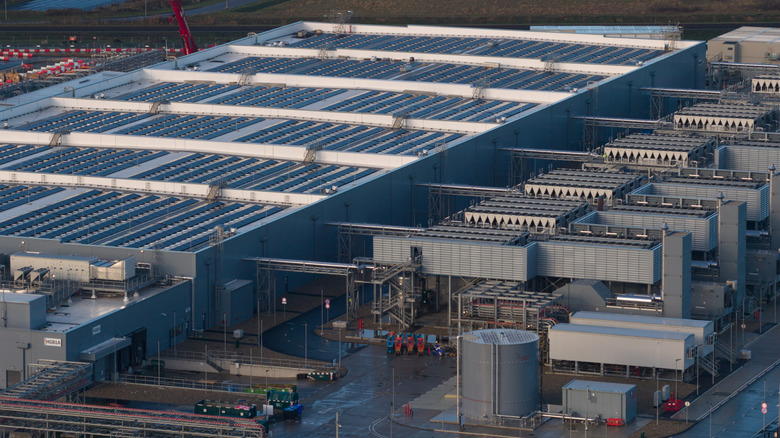
A typical data center uses a “fat tree” network structure. Data flows up and down a stack, with fat nodes at the top. Those fat nodes are powerful server clusters capable of breaking up bottlenecks created by the linear nature of the “tree,” which is a stack mostly made up of switches (which move data within a network) and routers (which move data between networks). Down near the “roots,” the pathways get thinner. Fat-tree structures require masses of cabling and tons of hardware, and while they’re generally reliable, they’re not particularly efficient.
Instead of the fat tree model, where traffic has to flow down a small number of fixed paths and can get jammed up, a random network graph could allow them to move across a larger number of random routes, creating many alternative paths between any two points. The challenge is implementing that idea with physical cabling. Enter the ShuffleBox, which can shuffle physical cables randomly, according to the random network graph concept. An important part of the design is optical circuit switching (OCS). This method transmits data from a start point to an end point purely as light inside fiber optic cables. It’s more efficient than traditional data transmission because, unlike the conventional method, it doesn’t require the data to stop at various points, get translated into electrical energy, then translated back into light at the next node or destination.
Spraypoint helps by doing what it says on the tin: rather than sending data packets along one best path, it “sprays” them randomly across multiple neighboring routers. The packets are then picked up by a number of intermediate routers standing by to send them on to the proper destination. It spreads traffic out to avoid congestion and reduces crowded hotspots.
Why the breakthrough is so important

Reducing the power draw of data centers is vital to ensuring their construction doesn’t decimate the environment and power grid. For example, Syracuse stated that there are currently 30 data centers seeking construction permits in New York State. If all of them are built, they’ll use more power than the nation of Ireland, putting additional stress on an aging grid already badly deteriorating after years of deferred maintenance and underinvestment.
It’s a common issue nationwide. Analysis by Bloomberg showed that customers as distant as an hour’s drive from new data centers could expect to pay up to 267% percent more for utility bills than five years prior. That means nearly tripling utility costs that are already skyrocketing to record highs. While hardly a panacea, Amazon’s RNG technology could make a significant impact, given that the company uses a staggering amount of energy and was revealed in 2025 to have twice the number of active data centers than previously estimated (per SourceMaterial with Bloomberg).
The same report points out that Amazon’s data centers are driving the construction of new gas plants and extending the life of existing coal plants that may otherwise have been retired. The size of data centers is also concerning for nearby residents, with Meta’s Louisiana data center measuring nearly 70 football fields in length. The environmental impact is also significant. A separate 2025 SourceMaterial report illustrated how Amazon, alongside Google and Microsoft, is operating (and continuing to construct) data centers, which rely on huge amounts of water for cooling, in some of the driest areas of the world.