Read more at:
A hard drive stores your data, such as files, apps, the operating system, and more of your device. What makes this product unique is that the information continues to be stored inside of it even if the power is down or if the computer/smartphone is turned off. There are two kinds of hard drives: the old-school HDD, a mechanical hard drive, and the new SSD standard, or solid-state, which uses flash memory.
Lesser known, these hard drives can have four different interfaces. PATA is an older interface that is already obsolete and found in really old computers. The SCSI/SAS standard is focused on enterprise, where it’s easier to scale stored information in data centers; SATA is still common, but it’s going away, while NVMe is the new standard for performance. Each of these hard drive interfaces has a meaning and purpose, even if some are already being phased out in favor of more advanced technologies. Still, understanding the difference between them can help you make a smarter decision when buying a new computer or an external storage, as you’ll know what you should expect from this product.
PATA
PATA, or Parallel ATA, is a legacy storage interface that connects drives to a computer’s motherboard. This technology transfers multiple bits simultaneously across a wide ribbon cable. It was designed and widely used from the late 1980s through the early 2000s, as it was designed for internal storage devices such as hard disk drives and optical drives.
This technology was important to keep costs low and installation relatively straightforward for users, as it would typically support two devices per channel, while earlier storage setups would need separate controller cards and standardized connections across manufacturers. PATA used to offer a unified, relatively inexpensive solution with maximum speeds of 133 MB/s in its final version. Still, it was eventually phased out due to signal integrity limitations in its design, which made it difficult to scale speeds further, along with practical drawbacks like bulky cables that could restrict airflow in new compact PC cases.
That said, this is when the Serial ATA (SATA) was introduced to address these constraints and not only improve performance but also allow manufacturers to create smaller and thinner computers. This is why PATA is now considered obsolete and can only be found in legacy systems or data recovery scenarios.
SATA
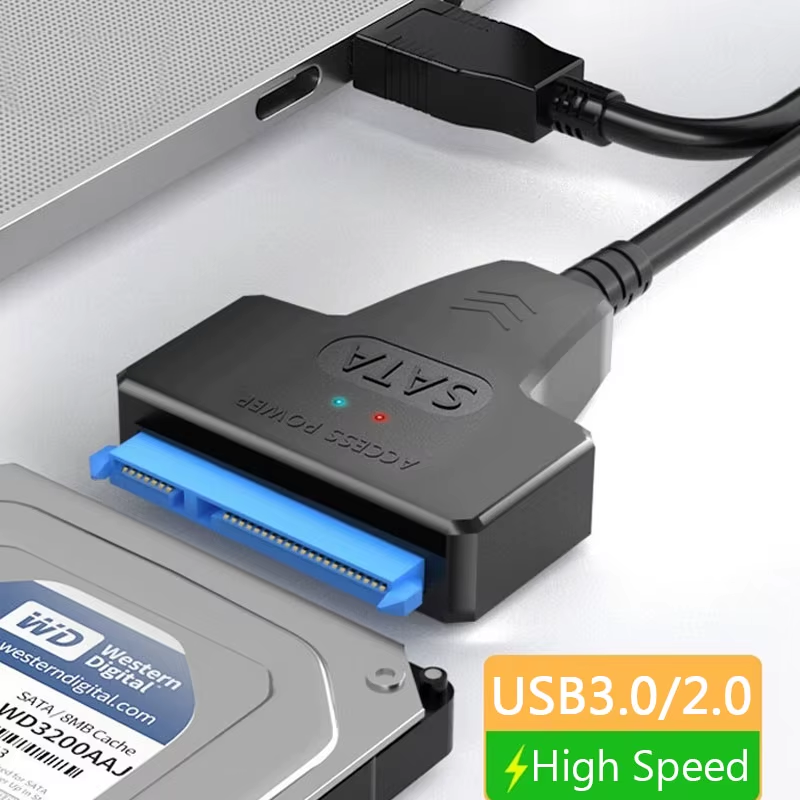
Serial ATA (SATA) is the storage interface that replaced Parallel ATA as it changed from parallel to serial data transmission (as the name suggests). Being more technical, each drive of this HD would connect directly to the motherboard rather than sharing a channel. It also had narrower cables, which improved airflow and made installation a lot simpler.
This technology started to roll out in the early 2000s, and it’s still possible to be found not only in HDDs but also in cheap SSDs. Following its years of improvements and development, SATA went from 1.5 Gb/s to 6 Gb/s in SATA III. Beyond speed, however, the SATA interface featured improved usability and system design, as it would allow drives to be connected or removed without shutting down the system, and it offered optimized capabilities for how it would handle reading and writing requests.
Still, like any good technology, SATA is reaching its limits as its bandwidth becomes the bottleneck for modern solid-state storage. This is why when you’re shopping for new computers and storage, the new favorite is NVMe drives over PCIe, as they’re a lot faster with lower latency. While SATA won’t disappear like PATA (at this moment), know that NVMe is the technology you should be looking for.
SCSI/SAS, enterprise focus
Just like consumer storage interfaces evolved over time, storage for enterprise data also went through important changes over the past 40 years. At first, there was the Small Computer System Interface, which allowed multiple devices to connect and communicate over a single bus. This standard was widely used from the 1980s through the early 2000s in workstations and servers.
While SCSI thrived in environments that required consistent performance under heavy workloads with multiple commands simultaneously, traditional parallel SCSI systems were too complex to configure, which limited their appeal outside enterprise use. Besides that, just like PATA transitioned to SATA, the storage demands for enterprise evolved, so SCSI transitioned to Serial Attached SCSI (SAS).
To this day, enterprise companies use SAS as it improves scalability, reliability, and data integrity while still supporting higher speeds. The standard behind this technology also added backward compatibility with SATA drives, which opened up the doors for mixed environments in servers. That being said, it’s rare to see consumer devices with SAS, as SATA and NVMe offer lower costs and have simpler implementation, which means that most customers will never interact with SCSI or SAS, unless they work with servers or professional-grade storage systems.
NVMe, the newer standard
Non-Volatile Memory Express (NVMe) is a modern storage interface designed for solid-state drives, which has been replacing SATA. It uses the Peripheral Component Interconnect Express (PCIe) bus, which allows storage devices to communicate directly with the CPU at much higher speeds. While SATA was still built for hard disk drives, NVMe was created with flash memory in mind, which means it gets significantly higher bandwidth and lower latency.
Technicity aside, this means that users get faster boot times, quicker file transfers, and a more responsive system in general. For example, SATA SSDs can top out around 600 MB/s, while NVMe drives can reach several gigabytes per second depending on the PCIe generation, and this is also why Apple keeps claiming reading and writing speeds for every new MacBook Pro just get faster and faster.
Still, it’s interesting to notice that NVMe doesn’t translate as a must for every user. If you usually do simpler tasks on your device, like web browsing or editing documents, the difference between SATA and NVMe won’t be that noticeable. For workloads involving large files, gaming, or even professional applications, you can see the real difference between the generations. That said, SATA remains relevant for those on a budget, while NVMe represents the current direction of storage technology.