Read more at:
Chinese authorities and industrialists have long hoped to unseat the United States as the world’s premier tech giant, but they’ve historically struggled to make inroads against Silicon Valley supremacy. However, recent and rapid advancements in artificial intelligence could catapult China ahead of its Western competition. Chinese-made humanoid robots are hitting the consumer market ahead of American brands like Tesla and Boston Dynamics, demonstrating unique designs unlike anything available in the west. Perhaps the most surprising of these designs is GrowHR, a robot that can shape-shift, walk on water, and move through spaces no human could fit in; plus, it does it all with a smile on its face.
GrowHR looks like a giant marshmallow with a cartoon grin (and a pair of painted-on overalls for some reason), but its goofy appearance belies some seriously impressive technology. The invention was unveiled in a research paper published in the journal Science Advances in January 2026, in which its creators put forth exciting specs, like the fact that GrowHR is capable of shrinking its height and width to 36% and 61% of its original stature in order to crawl through small spaces. It’s nearly four and a half feet tall, but weighs less than 10 pounds, allowing it to float with ease. GrowHR stands out because its soft, flexible form is in complete contrast to the hard metal robot companions other brands, like Tesla’s Optimus, are peddling. That contrast is purposeful, stemming from a goal to make GrowHR more human than other robots.
GrowHR was inspired by real human biology
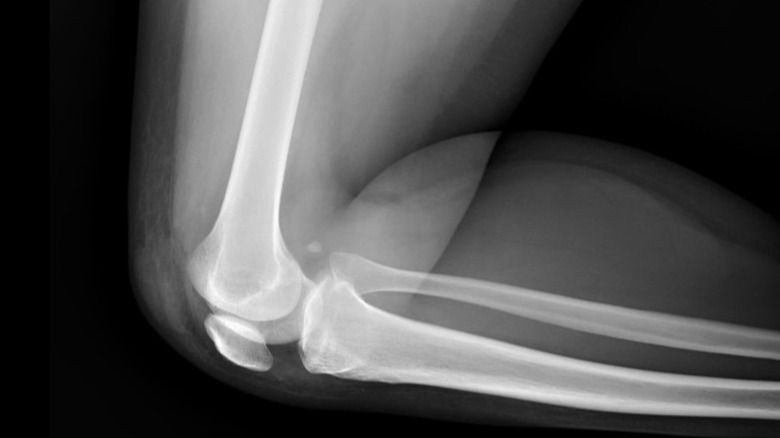
GrowHR was created at the Southern University of Science and Technology (SUSTech) in Shenzhen by a team of robotics researchers with a fixation on one specific thing: human bones. In their paper, the researchers cite bone structure as one of the main ways in which human biology still beats available robots, highlighting that bones are not just strong, but also hollow, making them lightweight yet capable of bearing a significant load. “Despite that,” the authors write, “current humanoid robots’ frames are simple columns,” being both more rigid and heavier than bones.
The drawbacks are evident when looking at a product like the highly-publicized G1 humanoid robot from Chinese competitor Unitree, which is about the same height as GrowHR, but weighs nearly eight times more. To make their robot lighter, the team at SUSTech took a cue from human bones and built GrowHR’s body and legs from a series of inflatable chambers. When the chambers are filled with air, the robot stands tall, but when they deflate, the robot shrinks in both height and width. The inflatable form is key not just for shape shifting, but for buoyancy; keeping GrowHR light enough to float, swim, and even stand on water. It’s a versatile design, but at this point, GrowHR is just a prototype. There are no concrete plans to bring GrowHR to consumers just yet, but its designers hope their technology could pave the way for groundbreaking future developments.
GrowHR could pave the way for life-saving technologies

Although GrowHR is far from a complete product at this point, its designers already see exciting potential for their robot in several fields of work, particularly search and rescue operations. GrowHR’s two greatest advantages over other humanoid robots today are its ability to adapt to varying physical spaces and its ability to swim, both of which are naturally advantageous for hazardous rescue missions. With its buoyant, air-filled body and limbs, the robot can even act as an animated lifesaver, offering stable support for a drowning person to grab ahold of while GrowHR propels itself to shore.
Its soft body could allow GrowHR to potentially navigate dangerous spaces unsafe for human rescue teams to enter. By the same property, the robot is also very resilient to damage. Its air chambers provide cushioning from falls and collisions, which is a significant asset when venturing into potentially hazardous spaces, such as collapsed buildings, where heavy debris could come crashing down at any moment. Combine that technology with robot eyesight, and you might have the ideal search and rescue operative.
Unfortunately, one thing that really holds GrowHR back for the moment is its ineptitude on foot. A soft body is essential for flexibility and cushioning, but it also limits the robot’s load-bearing power on land. While it moves easily in the water, its limbs bend under surface gravity and its footsteps are slow and awkward. Nevertheless, it is a novel design with a very unique kind of potential.