Read more at:
We may receive a commission on purchases made from links.
Mini-LED TVs are, as the name implies, panels with many smaller LED lights rather than the larger ones in a standard LED panel. With this advanced backlighting, they can achieve higher peak brightness, deeper blacks, and even more vivid pictures. Samsung’s latest lineup of Mini-LED TVs emphasizes value, which might make these luminous displays seem “cheap” compared to other innovative panels on the market today. With that in mind, how long can you actually expect your Mini-LED TV to last?
According to Samsung, the industry standard LED lifespan is 100,000 hours. That equates to over 11 years of continuous use. The expert testers at RTINGS verified (via Tom’s Hardware) that most TVs can last for over 10,000 hours even under intense conditions, with Mini-LED panels performing particularly well in the exhaustive experiments. Clearly, Mini-LED panels have longevity built in and are not necessarily shoddy even at value prices. And even if one tiny diode does cease to function, it will be hardly noticeable among the cluster of many adjacent diodes still shining bright.
Do Mini LED TVs last longer than OLEDs?
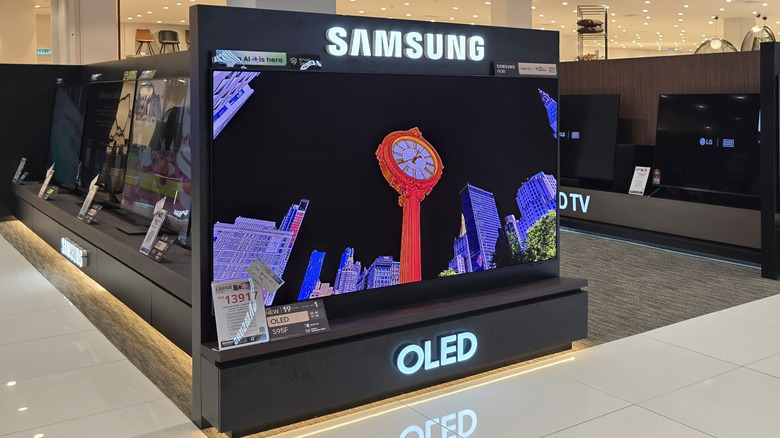
If you’re shopping for a modern TV, then Mini-LEDs and OLEDs will likely be at the top of your list. Users say that OLED TVs are actually reliable. If you’re looking for a long-lasting panel, though, a Mini-LED is preferable. The test by RTINGs found that OLED panels can also last for over 10,000 hours under the most strenuous conditions, but they’re also more susceptible to burn-in. Even though a Mini-LED display is brighter than its OLED equivalent, it will likely last at least as long and is less likely to suffer noticeable damage.
You might expect that a brighter Mini-LED TV draws more power or generates more heat, creating more opportunities for damage or for pixels to burn out. But because a Mini-LED TV’s brightness stems from its sheer number of diodes (over 20,000 in the case of the TCL X11L Mini-LED), the brightness and heat are actually distributed evenly across a greater number of respective diodes. This means these TVs actually require a lower, cooler electric current. Therefore, there’s less thermal stress on the overall panel, which would otherwise cause various components to degrade over time.
Of course, there are reasons you might pick an OLED panel when you’re deciding between the most cutting-edge TVs. There are particular disadvantages of Mini-LED TVs you should know before simply choosing one for its longevity. Overall, though, you can expect your Mini-LED TV to last for 10 to 15 years or more if you treat it well.